
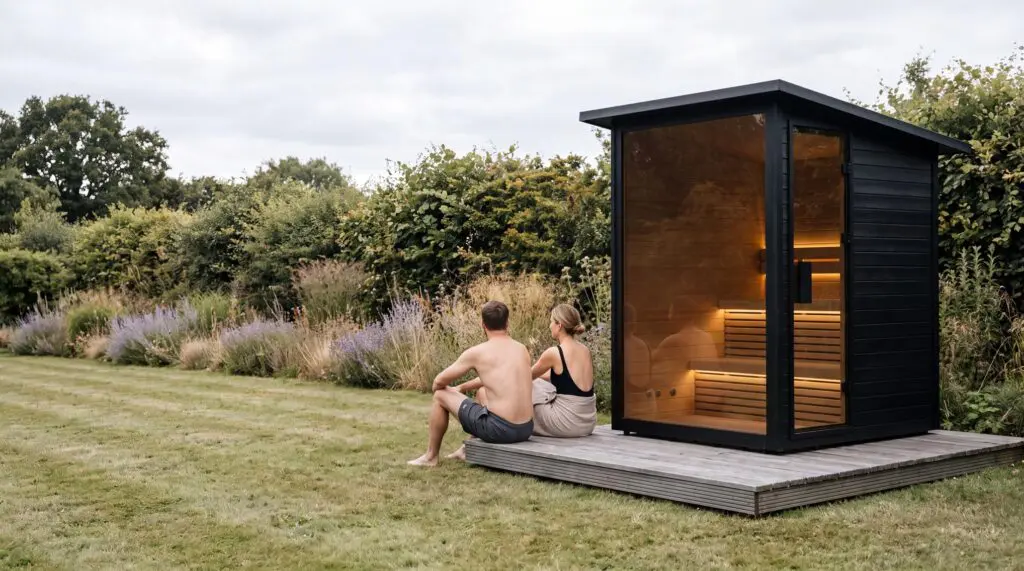
Most garden saunas get their heaviest use between October and March, usually after dark. That changes how you should plant around one. The garden you walk through in a towel on a January evening matters more than the one you look at in June.
Planting is also what makes an outdoor sauna look like it belongs. Without it, even a beautiful barrel can look like a shed at the end of the lawn. This guide covers what to plant, where to plant it, and how to grow your own birch for a sauna whisk. If you’re still choosing a sauna, start with our range of outdoor saunas.
Start with what not to plant
A few rules protect the sauna itself. Get these right first.
Keep a clear strip around the walls. Leave at least 3 feet clear between the sauna and any planting. You need that space for maintenance, and timber needs air moving past it to dry out after rain. Plants pressed against the walls hold moisture against the timber and hide problems until they’re expensive.
Don’t grow climbers on the sauna. Ivy, clematis and wisteria all trap damp and work their way under cladding. If you want greenery on a wall, put up a freestanding trellis a short distance away and grow the climber on that.
Keep trees back from the roof. Birch is lovely, but it drops seeds, catkins and leaves. Those block gutters and sit wet on the roof. Plant trees far enough away that the canopy will never hang over the sauna, even when it’s fully grown. In much of the US, silver birch is badly hit by the bronze birch borer, so choose river birch instead.
Mind the flue. If your sauna has a wood-burning heater, keep anything dry and flammable well away from the chimney. That includes conifers, ornamental grasses and overhanging branches. Sparks are rare, but dry grass in late winter catches easily.
Plan for water. Rain runs off the roof in one or two places. If you have a shower or cold plunge, that water goes somewhere too. Put plants that like damp ground there, rather than fighting it.
The sauna itself needs a solid, level base, such as a concrete slab or reinforced paving. Never stand it on grass or gravel, and keep your planting off the base.
Plant for winter first
Most garden planting is designed to peak in summer. A sauna garden should peak in winter, because that’s when you’ll see it most.
- Pale bark. Birch trunks almost glow at dusk, and even more under a single outdoor light. A multi-stem birch gives you several trunks from one tree.
- Colored stems. Red osier dogwood looks dull all summer, then turns bright red once the leaves drop. Cut it back hard every spring or two and the new stems give the best color.
- Grasses. Leave them standing through winter. Frost on the seed heads is one of the best things you’ll see on the walk back from a session.
- Evergreens. Eastern white pine, yew and boxwood keep some structure when everything else has died back.
Keep the lighting low and warm. A light angled up into a birch does more for the space than a floodlight on the door.
Screening for privacy
You’ll be walking about in a towel, so think about who can see you. Look from the sauna door and the route back to the house, then check which upstairs windows next door overlook them.
- Beech and hornbeam hedges are deciduous but keep their dead leaves through winter when you trim them. So they screen all year, and they turn a warm copper color.
- Yew is the classic dense evergreen hedge. It’s slow to start, but it lasts for decades. Every part of it is toxic, so think twice if you have young children or dogs.
- Pleached trees, such as hornbeam trained flat on a frame, screen at the height of a second-floor window without taking ground space. They suit small gardens.
- Clumping bamboo, such as Fargesia, makes a quick, soft screen that rustles in the wind. Choose a clumping type. Running bamboo will spread under fences and paths.
A Nordic planting palette
Planting with a Finnish feel suits almost any sauna, and most of it grows happily in gardens with cool, damp winters. Some of it needs acid soil, so check yours with a cheap testing kit before you buy. Ask for plants by their Latin name at the garden center, because common names vary from place to place.
| Layer | Plant | Latin name | Notes |
|---|---|---|---|
| Trees | River birch | Betula nigra | Pale, peeling bark all winter |
| Trees | Eastern white pine | Pinus strobus | Evergreen structure |
| Trees | American mountain ash | Sorbus americana | Red berries in fall |
| Trees | Serviceberry | Amelanchier canadensis | Native to North America. Stays small, flowers in spring and colors well in fall. A good choice for a small garden |
| Shrubs | Red osier dogwood | Cornus sericea | Native. Bright red stems once the leaves drop |
| Shrubs | Low juniper | Juniperus communis, low-growing forms | Evergreen, and useful for the sauna bucket |
| Shrubs | Heather | Calluna vulgaris | Needs acid soil |
| Ferns and shade plants | Male fern | Dryopteris filix-mas | Copes with dry shade too |
| Ferns and shade plants | Ostrich fern | Matteuccia struthiopteris | Likes damp ground |
| Ferns and shade plants | Hosta | Hosta | Protect from slugs |
| Ferns and shade plants | Astilbe | Astilbe | Good on the shady, damp side of the sauna |
| Grasses | Tufted hair grass | Deschampsia cespitosa | Leave standing over winter |
| Grasses | Purple moor grass | Molinia caerulea | Leave standing over winter |
| Ground cover | Creeping thyme | Thymus serpyllum | Scented when walked on |
| Ground cover | Lingonberry | Vaccinium vitis-idaea | Needs acid soil |
| Ground cover | Wild strawberry | Fragaria virginiana | Spreads gently in light shade |
Plants from hot, dry climates, such as olives, agaves and palms, look odd next to a timber sauna. They also hate the damp ground near a shower or plunge.
Make a cool-down area
The few feet outside the sauna door do a lot of work. You’ll stand there to cool off, walk there barefoot, and probably drip on it.
Stepping stones with creeping thyme or chamomile between them are softer underfoot than gravel. Both plants cope with being walked on, and they release their scent when you do. Add a bench in a spot that gets afternoon sun. Put plants that like damp ground where a cold plunge or shower drains.
If you’re planning a plunge alongside the sauna, our guide to sauna and cold plunge at home covers where to put it.
Grow your own sauna whisk
In Finland, a bundle of fresh birch branches called a vihta is part of the sauna. You tap it lightly over your skin in the heat, and the leaves fill the room with a fresh, green smell. If you have a birch tree, you can make your own.
Which birch. Finns use both silver birch and downy birch. If you’re planting one partly for whisks, choose a multi-stem tree or keep it pruned low. You want plenty of young, flexible branches within reach.
When to cut. Early summer, once the leaves are fully open but still soft. Finns traditionally make whisks around midsummer. Later in the year the leaves toughen up and drop off more easily.
How to make one. Cut 25 to 40 leafy branches, each about 20 inches long. Strip the leaves from the bottom 6 inches to make a handle. Lay the branches together with the flattest side of the leaves facing the same way, then tie the handle tightly with string or a thin twig.
Keeping them for winter. Use a whisk fresh, or hang it to dry somewhere cool and shaded. Wrapped and frozen, it keeps until winter. Soak a dried whisk in warm water for a few minutes before you use it, and it softens up again.
Juniper whisks exist too, but they prickle. Most people prefer juniper growing in the border. A few sprigs left to soak in the sauna bucket give the steam a resinous smell without the sting.
Which sauna shape suits which garden
The planting and the sauna should work together.
- Barrel saunas are the traditional shape and suit looser, woodland-edge planting: birch, ferns and long grass.
- Cube saunas have straight lines and a modern look. They pair well with grasses in drifts, a clipped hedge and stone paving.
- Cabin saunas have room on the porch for pots, so you can plant around the door even on a patio.
A small garden version
You don’t need a large plot. One multi-stem serviceberry or river birch, a pot of grasses by the door, and thyme between three or four stepping stones is enough to make the sauna feel planted. Keep to the 3-foot clear strip and you’re done.
You can see Hekla outdoor saunas in person at a stockist near you. Take a few photos of your garden along, and they’ll help you choose the shape and size that fits.

