

Sauna Buying Guide
Indoors or out. Traditional heat or infrared. Which Harvia heater, at what output, with which controls. Everything you need to decide before you buy, in the order the decisions actually matter.
Where to start
Six decisions, in the order they matter
Buying a sauna involves more choices than most people expect, and they build on each other. Decide where it goes and everything else narrows quickly.
If you want the short version: choose an infrared sauna for gentle heat indoors with no electrician needed, a traditional sauna for the authentic Finnish ritual, or one of our outdoor saunas if the garden is calling. Then work through heater, output, controls, size and siting below.
Decision one
Indoor or outdoor?

Indoors
A spare room, ready to use
An indoor sauna goes in a spare room, a large bathroom, a garage, a basement or a utility space. There is no base to lay, no weatherproofing and nothing to dig. You need a level floor, enough headroom and a power supply.
It is the lower-effort route, and with infrared there is no electrical work at all. Browse our indoor saunas.

Outdoors
A destination in the garden
An outdoor sauna becomes a feature of the garden, and the walk back to the house through cold air is part of the pleasure. It also keeps the heat, humidity and footprint out of the house entirely.
In exchange it needs a prepared base, clear access for the build and an outdoor-rated supply. There is more to organise up front, which we cover in decision six. Browse our outdoor saunas.
Decision two
Traditional or infrared?
Traditional
70 to 90°C
The classic ritual
A stove and stones heat the air, and you ladle water over the rocks for a wave of loyly steam. Ready in 30 to 45 minutes. Needs 6 to 9 kW wired in by an electrician.
Infrared
45 to 60°C
Calm, everyday heat
Panels warm your body directly, so the cabin stays cooler while you still sweat deeply. Ready in 10 to 15 minutes, around 2.4 kW, and plugs into an ordinary socket.
The Harvia heaters we specify


Decision three: choosing your heater
Our garden saunas can be heated either way, and it is a genuine choice rather than a budget one.
Harvia Cilindro (electric). A sculptural free-standing column heater whose steel basket holds a generous bed of stones, radiating heat from every side. Ready to bathe in 30 to 45 minutes, with precise temperature control and no fuel or flue to manage. Available at 6.8 kW and 9 kW.
Harvia Linear 18 (wood-fired). A 14.3 kW wood-burning stove for the traditional experience, with a deep enveloping heat no electric heater quite matches. It needs no power supply for heat, so it suits gardens beyond a convenient electrical run.
Both reach full loyly temperature. The honest summary is convenience against authenticity. Wood means storing fuel, lighting it around 45 minutes ahead, and clearing ash.
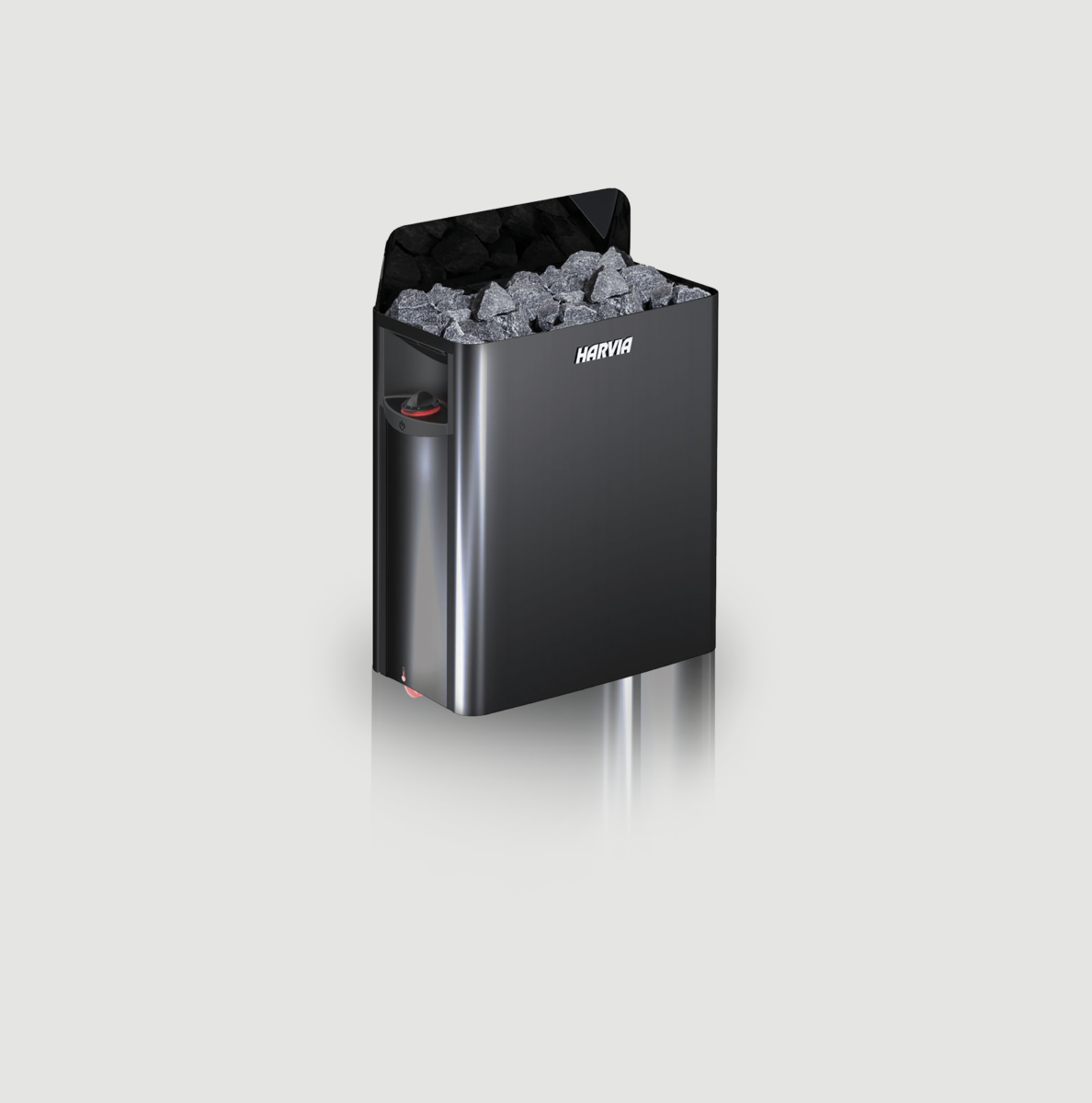
Indoor traditional cabins use the Harvia The Wall, a slim wall-mounted electric heater. Output follows cabin size:
- Traditional 160 (2 to 3 people): 6 kW or 9 kW
- Traditional 210 (3 to 4 people): 9 kW
- Traditional 210x (4 to 5 people): 9 kW
- Traditional 220 (5 to 6 people): 9 kW
More kilowatts does not mean a better sauna, it means a bigger room brought to temperature in a sensible time. Undersize the heater and it labours and never holds heat with a full bench. Oversize it in a small cabin and you gain nothing but a larger bill. On the smallest cabin, 6 kW is the sensible default and 9 kW gives faster heat-up.
This is the most overlooked decision on the page, and on our outdoor electric heaters it changes what the sauna can actually do.
- Manual (Cilindro PC90). A dial and timer on the heater itself. Simple and dependable, but it reaches a milder 60 to 70°C, so it suits gentler bathing rather than full Finnish heat.
- Digital plus Wi-Fi (Cilindro PC90XW). Heats to a full 110°C and includes the Harvia Fenix Wi-Fi control panel. This is the option we recommend and the one most customers choose.
- Digital (The Wall, indoor). Our indoor heaters come with digital control as standard, with Wi-Fi scheduling available through the Fenix panel.
If you want full-heat traditional bathing, choose a digital option. The manual heater is a fine thing, but its temperature ceiling is a real limit rather than a detail.
The Fenix is a 4.3 inch glass touchscreen that replaces the heater’s own controls, and it changes how you use a sauna day to day. You start it from your phone on the way home rather than remembering to walk out and switch it on.
- Remote start, scheduling and monitoring through the MyHarvia app
- Temperature from 30 to 110°C, plus humidity, lighting and ventilation control
- Three customisable presets and a smart timer
- Learns how your heater performs to reach temperature efficiently
- Wall-mounted, so it can sit in the sauna, the bathroom or the living space
Wood-fired saunas are controlled the traditional way, by how you build and feed the fire. There is no thermostat, which is either the appeal or the drawback depending on your temperament.
The numbers that decide it
2.4 kW
Infrared, plug-and-play. No electrician needed.
6 to 9 kW
Traditional electric, hardwired by a qualified electrician.
14.3 kW
Harvia Linear 18 wood burner. Needs no power supply.
110°C
Full heat, available with digital and Wi-Fi controls.
A note on outputs
We match the heater to the cabin, so you do not need to size it yourself. The options listed on each model are the ones that suit it.

Thermally modified aspen.
Every Hekla cabin is lined in thermally modified aspen: timber baked rather than treated, so it resists moisture and movement, stays kind to the touch at full heat and holds its colour for years. It is the reason a Hekla sauna still feels new after a decade of use.

Decision four
What size do you need?
Buy for how you will actually use it. Most home saunas are used by one or two people most of the time, and a bench you can lie down on matters more than a seat count you rarely fill.
2 person saunas suit compact spaces, solo sessions and couples, and are the fastest to heat and cheapest to run. 3 to 4 person saunas are the versatile middle ground for most households. 5 to 6 person saunas are for families and entertaining.
One practical note: a larger cabin takes longer to reach temperature and costs more per session. If it will usually be two of you, a smaller cabin is often the better sauna rather than a compromise.
Decision five
Choose your range
 4 models
Traditional
The original Finnish sauna. Ours heat the air with an electric heater and hot stones to an enveloping 70 to 90°C, with a rush of löyly steam on demand. Handcrafted in knot-free thermo-aspen for indoor rooms. Explore traditional saunas 4 models
Cube
The design-led garden sauna. Framed in glass beneath a sculptural cube roofline, our Cube saunas bring a modern architectural edge to outdoor bathing. Intimate, light-filled and with room for four. Explore cube saunas 2 models
Barrel
The timeless outdoor sauna. Our wooden barrel saunas are built from thermo-spruce staves and bring classic Nordic bathing to the garden. Quick to heat, full of character and roomy enough for the whole group. Explore barrel saunas 3 models
Infrared
The gentle, modern sauna. Infrared warms your body directly at a calmer 45 to 60°C, so sessions feel breathable and last longer. Quick to heat, economical to run and easy to enjoy every day. Explore infrared saunas 2 models
Cabin
The modern garden sauna. Our cabin saunas pair a weatherproof black exterior with a glass front and a warm thermo-aspen interior. Contemporary lines that make a striking addition to any outdoor space. Explore cabin saunasDecision six: where will it go?
For garden saunas the base must be prepared before build day, and must be flat, level, solid and permanent. A concrete slab is ideal, and reinforced patio or paving over a solid sub-base also works.
Grass, gravel, soil and any soft ground are not suitable. An uneven base compromises the structure and prevents correct alignment during the build, and base problems can affect your warranty. This is the single most common reason a build gets delayed.
Allow one metre of clear space on all sides of the footprint so the sauna can be assembled. Typical footprints:
- Cube 160: 1570 x 2250 mm
- Cube 210: 2250 x 2070 mm
- Cube 250: 2280 x 2470 mm
- Barrel 210: 2070 x 2250 mm
- Barrel 250: 2470 x 2250 mm
You will also need a clear access route at least one metre wide, with no obstructions such as furniture, fences or plants, and nothing overhead in the way such as branches, cables or rooflines.
Whoever builds the sauna, you or your Hekla stockist, assembles the structure, roof, waterproof membrane and shingles and finishes the exterior. Electrical work is separate. Your electrician handles:
- Drilling a suitable cable entry point
- Installing and connecting the heater
- Connecting lighting and controls
- Ensuring the work meets local regulations, then testing and certifying it
Plan this with a qualified electrician before your build is booked, so the sauna is not left finished but unusable. One last thing people forget: the sauna stones must be washed and fully dried before first use. Full detail is in our pre-delivery and build guide.
Running cost comes down to heater output, how long you heat for and how often. Infrared costs least per session because it warms you rather than the whole room and is ready in minutes. A 9 kW traditional cabin costs more per session but delivers heat infrared cannot.
We break the numbers down by heater type and size in our guide to how much a sauna costs to run. For purchase prices by tier, with every Hekla model listed, see how much a home sauna costs.
Buying guide FAQs
Most garden saunas fall under permitted development in the UK, but it depends on size, height, siting and whether your property has restrictions such as a conservation area or a listed building. Check with your local planning authority before you order.
Our indoor Traditional models are sauna kits and most assemble in a few hours, and our infrared cabins are plug-and-play. Outdoor saunas arrive as kits too. You can assemble one yourself or have your Hekla stockist build it, so ask them when you order. In every case the electrical connection must be completed by a qualified electrician and is not part of the build.
Use the options listed on the model you are looking at, as they are already matched to that cabin. On the smallest indoor cabin, 6 kW is the sensible default and 9 kW gives faster heat-up. Outdoors, choose a digital or Wi-Fi option if you want full 110°C heat.
Yes, honestly. You store and carry fuel, light it around 45 minutes before bathing, and clear out ash. For many people that ritual is exactly the point. If it sounds like a chore, choose electric.
Around 30 to 45 minutes for a traditional electric sauna, similar or a little longer for wood-fired, and 10 to 15 minutes for infrared. With the Fenix Wi-Fi panel you can start an electric heater remotely so it is ready when you are.
Choose traditional for the authentic high-heat ritual and loyly steam. Choose infrared for gentler warmth, faster warm-up, longer sessions and no electrical work. Our guide to infrared vs traditional saunas compares them properly.
Still deciding?
Specifications only take you so far. Five minutes on the bench of a traditional cabin and five in an infrared one will tell you more than any comparison table.
Popular Hekla saunas


Try one before you buy
Our stockists let you sit in a Hekla sauna, feel the difference between traditional and infrared heat, and talk through heaters and siting with someone who installs them.

"*" indicates required fields
"*" indicates required fields
Offers available at your nearest showroom – don’t miss out!
Would you like to receive these?
By submitting this form you agree to be contacted by Hekla Saunas & its authorised retailers.
No, just show me my nearest showroom